Vietnamese Immigrants in the U.S.
Vietnamese immigrants arrived in the US following a turbulent historical event in 1975, settling here for 47 years. Despite the birth of new generations, historical sorrow still dominates and shapes the tale of the Vietnamese in America.
A new storyline is long overdue, especially when in recent years, many young Vietnamese talents, particularly those in the field of technology, have immigrated to the nation in search of the new American dream.
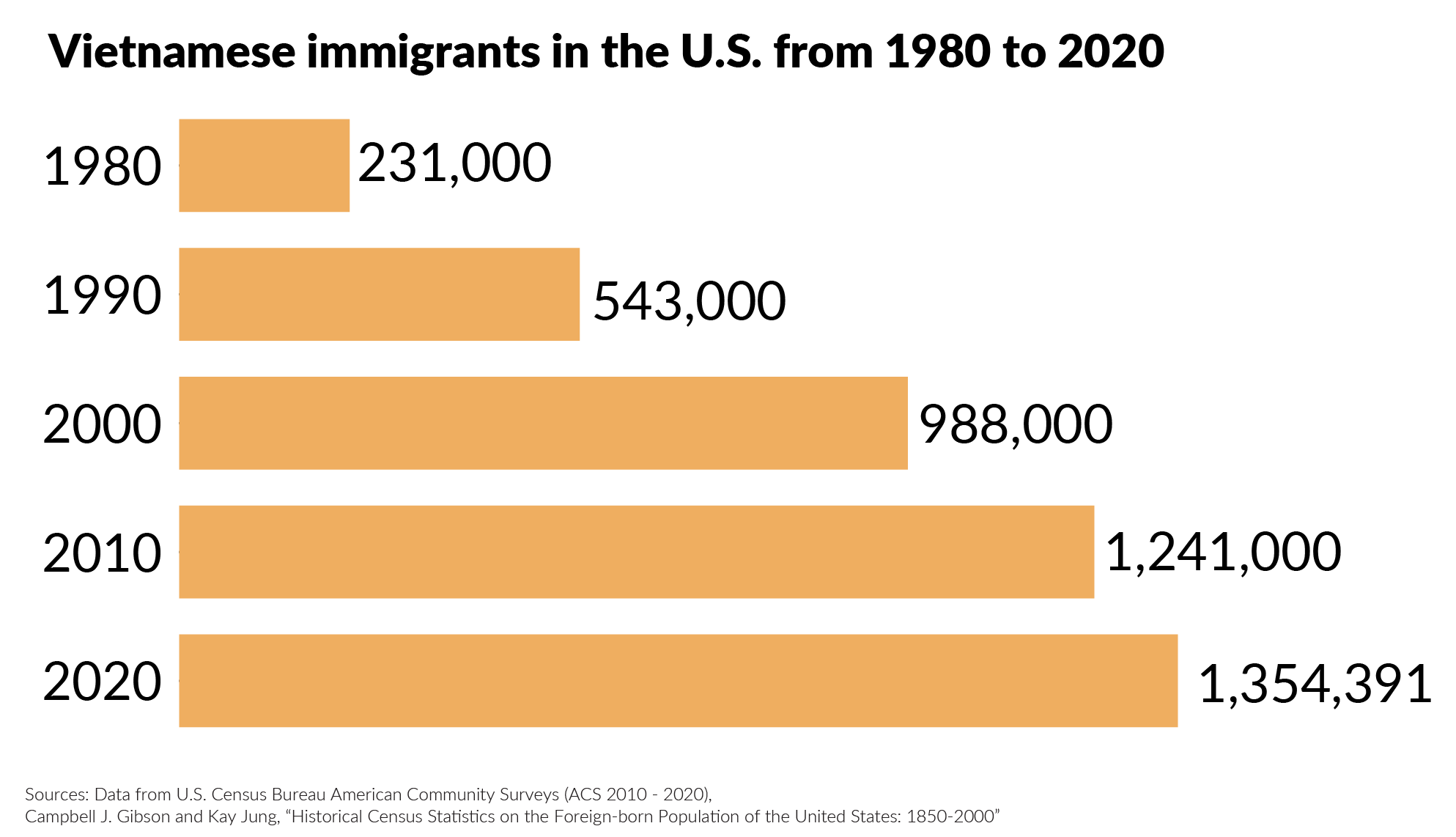
From 290 people who obtained lawful permanent resident status in the 1950s, in 2021, there were about 1,338,538 Vietnamese immigrants in the U.S. (data from Census Bureau 2021 American Community Survey, released September 15th, 2022). Vietnamese mainly immigrated to the U.S. in the 1970s and 1980s.
Over 50% of Vietnamese immigrants live in California and Texas
Vietnamese is one of the largest foreign-born groups in the United States, ranked 4th among Asian immigrant groups, after India, China (including Hong Kong), and the Philippines.
In 2021, over 51 percent of all Vietnamese immigrants lived in California or Texas. Since 2010, the top ten states with the most Vietnamese immigrants remain almost the same: California, Texas, Florida, Washington, Georgia, Virginia, Massachusett, Pennsylvania, New York, and North Carolina.
Los Angeles and San Jose are still "the capital" of Vietnamese in the U.S.
In terms of core-based statistical area (CBSA), in 2010, Los Angeles-Long Beach-Santa Ana (CA Metro Area), San Jose-Sunnyvale-Santa Clara (CA Metro Area), Houston-Sugar Land-Baytown (TX Metro Area), San Francisco-Oakland-Fremont (CA Metro Area), Dallas-Fort Worth-Arlington (TX Metro Area) were the most Vietnamese population density in the U.S.
However, in 2021, Seatle-Tacoma-Bellevue (WA Metro Area) replaced San Francisco-Oakland-Fremont in the top 5. Those 5 places acquired over 41% of all Vietnamese in the U.S.
Income and Poverty
The median household income of Vietnamese immigrants in 2021 was $74,588, higher than the median for immigrants in total and all the U.S. population in total, which were $69,622 and $69,717 respectively. Vietnamese income per capita was also higher than the U.S. population in total ($40,127 vs $38.332).
About 10.9% of Vietnamese families lived in poverty, compared to 12.5% of all immigrants.
Immigration Pathways and Naturalization
Immigrants from Vietnam are significantly more likely than the overall foreign-born population to be naturalized U.S. citizens or to obtain permanent resident status.
Acording to Homeland Security data, in 2020, Vietnam ranked 56th among the countries with the most nonimmigrant admissions to the U.S but ranked 5th among the countries with the most people obtaining lawful permanent resident status with 29,334 people.
As of 2019, 76 percent of Vietnamese immigrants were U.S. citizens, compared to 52 percent of the total foreign-born population, according to the Migration Policy Institute.
According to the data from Homeland Security Yearbook 2020, in the 1950 - 1960 period, there were only 290 Vietnamese obtaining lawful permanent resident status in the U.S., and the number was still low the next decade but rose by over 4000% in the 70s, due to the Fall of Saigon in 1975. Since then, the number has kept growing, but in a much smaller percentage: 65% in the 80s, 37% in the 90s, 5% in the 2000s and rose again by 23.4% in the 2010s.
The data on Vietnamese Americans is from the 2021 American Community Survey (ACS), Homeland Security Yearbooks, the Migration Policy Institute's studies.
Han Vu
This is the final project for my Multi Media Design class. Any suggestions or concerns, shoot me an email at han.vu@mail.missouri.edu
More information about me:
- My work as a graphics designer at Columbia Missourian
- My work as a political journalist at Thanhnien Newspaper
- My personal projects